The New Patient Journey Is Online First
Updated: Jun 23
The first appointment now happens long before the first appointment. By the time a patient picks up the phone to call your clinic, they have already searched your name, scanned your reviews, looked at your photographs, perhaps watched a video, and formed a fairly firm opinion. The call is a confirmation, not a discovery. Understanding this journey — step by step — is what “digital presence for doctors” actually means in practice.
The journey is now online-first
A generation ago, a patient found a doctor through a referral or a signboard and formed their impression in the waiting room. Today, particularly in India's cities and increasingly its towns, the sequence is reversed. The impression is formed online, across several touchpoints, and only then does the patient decide whether to make contact. Each of those touchpoints is a point at which the journey can quietly end. This guide walks through the full path and what each step requires of you.
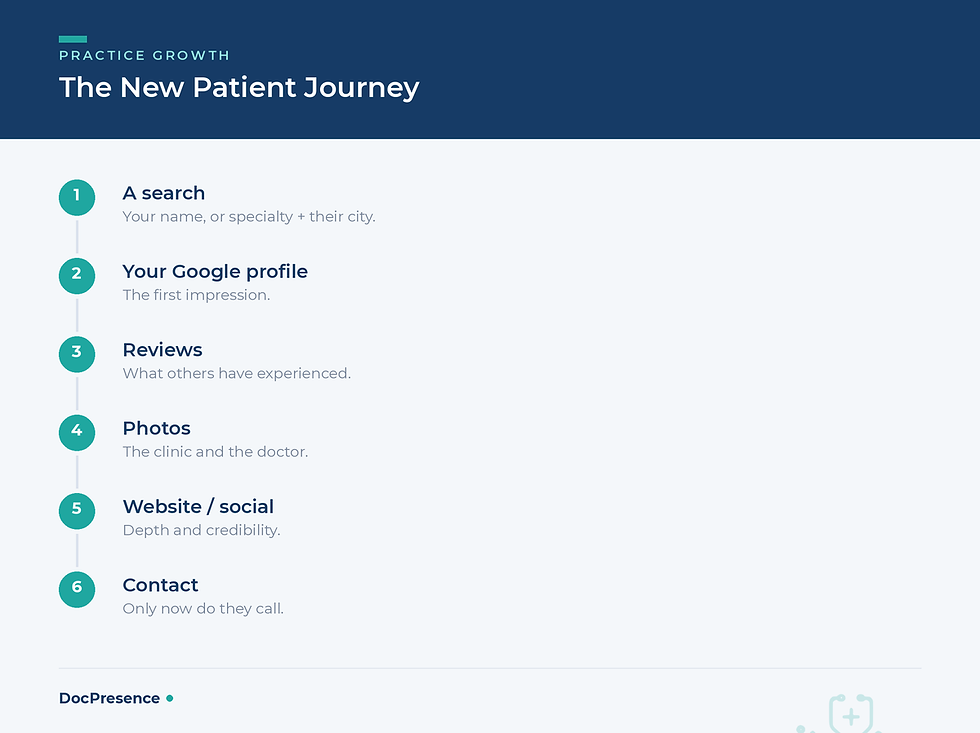
Step 1: The search
It begins with a query. Sometimes it is your name — a patient has been referred and wants to verify you before calling. Sometimes it is your specialty plus a location: “gynaecologist in .” Increasingly it is “near me,” with location implied. What you need at this step is simply to appear — which depends on a complete, correctly categorised Google Business Profile and consistent details across the web.
Step 2: The Google profile
The search returns your Google Business Profile first — rating, photographs, hours, and buttons to call or get directions. This is the first real impression, and for many patients the decision to call is made here, within seconds, without clicking further. An incomplete profile, missing photographs, or stale information ends a meaningful share of journeys at this exact step. Completeness here is not optional polish; it is the gate everything else sits behind.
Step 3: Reviews
Patients who are interested read reviews next. They are looking for evidence that others have trusted you, and — just as importantly — for how you respond. A steady flow of genuine reviews, each answered calmly and professionally, reassures. A cluster of unanswered complaints, or no reviews at all, gives the patient a reason to hesitate. Your replies are public and are read as a signal of how you treat people.
Step 4: Photographs
Before visiting, patients form expectations from images — the clinic's cleanliness, its professionalism, and the doctor's face. A clear, current photograph of the doctor does more to reduce a new patient's anxiety than almost anything else, because it answers the quiet question of who they will be seeing. Authentic images of the real space matter more than polished or staged ones.
Step 5: Website and social
The patient who wants more depth visits your website or social profiles. Here they confirm your specialty and the conditions you treat, read your qualifications and experience, and judge your tone. The website should make three things immediate: what you do, reassurance that they are in the right place, and an obvious way to take the next step. Social content, if present, should be calm, relevant, and consistent — reinforcing credibility rather than chasing attention.
Step 6: Contact
Only now, having moved through search, profile, reviews, photographs, and site, does the patient make contact — a call, a WhatsApp message, or a booking. By this point the decision is largely made; the contact step simply needs to be frictionless. A number that is one tap away, a WhatsApp Business line that is monitored, a booking path that does not demand a hunt — these convert a decided patient into an appointment instead of losing them at the last moment.
The chain is only as strong as its weakest link
The crucial point is that a patient can drop off at any step. A strong profile undone by no photographs. A good website undone by unanswered reviews. An interested patient lost because the phone number was buried. Digital presence means being present and credible at every step of this journey, not excelling at one and neglecting the rest. The weakest link sets the ceiling.
Where journeys most often break
In practice, the breaks cluster at a few predictable points. The most common is the profile step: a patient finds you but the profile is incomplete or photograph-less, and they move on before reading further. The second is reviews: either none exist, giving the patient nothing to go on, or complaints sit unanswered and read as inattention. The third is the contact step: the patient is convinced but the phone number is buried or the mobile site is slow, and a decided patient is lost at the last moment. Knowing where breaks usually occur tells you where to look first.
Mapping your own journey
The exercise is concrete. Take a phone, search the way a patient would, and write down what you find at each step — what the profile shows, what the reviews say and whether you have replied, what the photographs convey, whether the website answers the three questions, and how many taps it takes to contact you. The gaps will be specific and visible. Most practices find two or three, and fixing them is usually a matter of an afternoon rather than a project.
What this means for your practice
“Digital presence for doctors” is not a marketing slogan. It is the practical reality that the patient's decision is now assembled across several online touchpoints before any human contact occurs. Auditing each step from the patient's point of view — searching your own name on a phone and walking the path they walk — is the most direct way to see where your journey breaks and where a credible practice is quietly losing patients it should be winning.
DocPresence builds and maintains digital presence for doctors, clinics, and small hospitals across India. For a clear picture of how your practice currently appears online, request a digital presence audit.


Comments